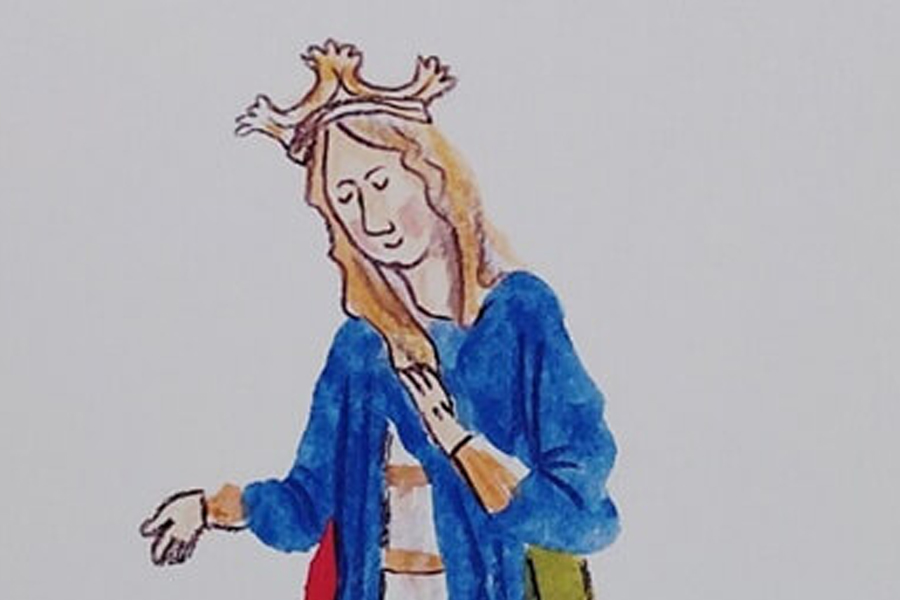
I have always been drawn to the strong women hidden in plain sight across medieval history. Edith Of Wessex stands out as one of the most fascinating. Born around 1025 and living until 18 December 1075, she rose from noble roots to become queen consort of England. Her life spanned massive upheavals. She married on 23 January 1045, endured exile in 1051, and outlasted the Norman Conquest in 1066. Through it all, she turned family ties into a fortress of influence. In this article I explore her story and every key relative who shaped her path. Get ready for dates, numbers, and a clear table that brings her world to life.
Edith Of Wessex: From Educated Noblewoman to Influential Queen
Her childhood inspires me. She was raised in the prestigious Godwin House. For a woman, her education at Wilton Abbey near Salisbury was unique. She learned English, Danish, French, Irish, and Latin. She studied language, rhetoric, arithmetic, astronomy, music, embroidery, and weaving. Skills became her secret weapons. After wooden constructions collapsed, she reconstructed the abbey church in stone. My mind imagines her needle creating a kingdom.
She married Edward The Confessor on 23 January 1045 and was fully crowned at Winchester’s Old Minster. This made her the only 10th- and 11th-century English monarch to receive such formal honors. Their marriage produced no children, although she attended court. In 1051, her family was exiled and she lost land. A nunnery housed her. In 1052, everything changed. She reclaimed authority after her relatives returned violently. From then on, she advised the king, witnessed charters, and appointed bishops. When Edward The Confessor died in 1066, she had 1570–2000 pounds a year. This made her England’s richest lady and the fourth richest overall. She held the Manor of Amersham first on record and owned huge southern domains. William the Conqueror admired her after 1066. She paid tribute, held most territories, and lived with her English retinue until her death.
I admire her 1065–1067 Vita Aedwardi Regis commission. People remember Edward The Confessor as saintly because of this work. It safeguarded her family name. The Bayeux Tapestry features her. Only three women attend. On his deathbed, she stands beside the monarch. Experts say she may have helped make the tapestry diplomatically. Her life is calm strong. She weaved chaos into legacy.
The Godwin Family Roots: Parents Who Built a Dynasty
Her parents formed the bedrock. I see them as architects of ambition. Her father Godwin, Earl of Wessex, lived from around 1001 to 1053. He rose from military service under Cnut the Great to become the most powerful earl in England. He served under four kings and arranged her marriage to secure family control. His death in 1053 left a power vacuum she helped fill.
Her mother Gytha Thorkelsdottir lived from around 1000 onward. This Danish noblewoman brought crucial alliances. As sister in law to Cnut the Great she linked English and Scandinavian worlds. Together the couple raised at least nine children. Their home pulsed with strategy. I imagine family dinners where plots and alliances flew like arrows.
Siblings and Extended Kin: The Network That Powered Her Reign
Edith Of Wessex drew strength from her brothers and sisters. Their stories read like chapters in an epic. Here is a table I compiled to map them clearly. It includes dates, roles, and key ties to her.
| Family Member | Relationship to Edith Of Wessex | Birth and Death Years | Key Role and Connection |
|---|---|---|---|
| Sweyn Godwinson | Brother | Around 1020 to 1052 | Eldest, outlawed for crimes, limited direct link but part of family rise |
| Harold Godwinson | Brother | Around 1022 to 1066 | Became Earl of Wessex and King Harold II, died at Hastings, strong political ally |
| Tostig Godwinson | Brother | Around 1026 to 1066 | Favorite of Edith Of Wessex, made Earl of Northumbria in 1055 with her help, died at Stamford Bridge |
| Gyrth Godwinson | Brother | Around 1030 to 1066 | Died alongside Harold at Hastings |
| Leofwine Godwinson | Brother | Around 1035 to 1066 | Died at Hastings |
| Wulfnoth Godwinson | Brother | Around 1040 to 1094 | Youngest, held hostage in 1051, later imprisoned by William the Conqueror |
| Gunhild | Sister | Around 1035 to 1080 | Part of sibling network supporting court influence |
| Aelfgifu | Sister | Dates approximate | Supported the large Godwin family web |
Nephews, Nieces, and the Next Generation
Through Harold Godwinson she became aunt to several. Magnus Godwinson was her nephew. Gunhild Of Wessex was her niece. Gunhild studied at Wilton Abbey just like her aunt. After 1066 she stayed there until an abduction in 1093. These ties extended the Godwin reach. I picture Edith Of Wessex guiding the young ones with stories and skills from her own abbey days.
Marriage to Edward The Confessor: Duty, Tension, and Quiet Respect
Their 21 year union started as pure politics. Edward The Confessor, born around 1003 and died 5 January 1066, was about 20 years older. He resented her father for past events including the death of his brother Alfred. Early years felt cold. Languages differed. In 1051 he banished her. Yet 1052 brought reconciliation. By his deathbed he called her a loving daughter. She warmed his feet in the tapestry scene. No romance bloomed, but mutual respect grew. She helped welcome Edward the Exile in 1057 and educated his daughter Margaret who later became Queen of Scotland. Their childless marriage sparked succession drama, yet she turned it into opportunity.
Career, Wealth, and Lasting Achievements
She was more than queen consort. She advised on appointments and church endowments. She donated Abingdon Abbey land and backed Bishop Giso of Wells. The numbers speak. Her annual income was 1570–2000 pounds. She had a goldsmith and relics. She stone-built Wilton after 1066. Her biggest achievement was survival. Battle killed most siblings. She maintained rank under William. I liken her to a diplomat navigating rough waters. She ordered Edward The Confessor’s main biography and may have influenced the Bayeux Tapestry. Patronage, embroidery, and music characterized her work. She advanced court culture and preserved English history.
Extended Timeline of Key Moments
To track her path I built this timeline table. Dates and numbers highlight the pace of her life.
| Year or Period | Event |
|---|---|
| Around 1025 | Birth to Godwin and Gytha |
| Early childhood | Education at Wilton Abbey in five languages and arts |
| 23 January 1045 | Marriage and coronation with Edward The Confessor |
| 1051 | Family exile, her banishment to nunnery, lands seized |
| 1052 | Return and rise in influence |
| 1053 | Father Godwin dies |
| 1055 | Helps Tostig become Earl of Northumbria |
| 1057 | Welcomes Edward the Exile and aids his children |
| Around 1064 | Linked to Gospatric murder rumors tied to Tostig |
| 1065 | Northumbrian revolt forces Tostig exile |
| 5 January 1066 | Edward The Confessor dies, she stands at his side |
| 1066 | Harold reigns briefly, brothers fall at Stamford Bridge and Hastings |
| 1065 to 1067 | Commissions Vita Aedwardi Regis |
| After 1066 | Pays tribute to William the Conqueror yet retains estates |
| Later years | Rebuilds Wilton Abbey, reads saints lives |
| 18 December 1075 | Dies at Winchester, buried beside Edward in Westminster Abbey by William the Conqueror |
FAQ
How did Edith Of Wessex rise from noble daughter to crowned queen?
She leveraged her father Godwin influence. The 23 January 1045 marriage sealed a political deal. Her coronation the same day marked her formal status. Education and family ambition turned opportunity into power.
What role did her brother Tostig play in her life?
Tostig was her close favorite. In 1055 she helped him secure the earldom of Northumbria. Their bond mixed affection with controversy. She faced accusations over the 1064 Gospatric murder tied to his interests. He died in 1066 at Stamford Bridge.
Who were the parents of Edith Of Wessex and what did they contribute?
Godwin, Earl of Wessex from around 1001 to 1053, built massive power through service to multiple kings. Gytha Thorkelsdottir from around 1000 onward brought Danish alliances. Together they created a dynasty that placed her on the throne.
Did Edith Of Wessex have any children and how did that affect her?
No children came from her marriage to Edward The Confessor. The childless union fueled succession crises. Yet it freed her to focus on patronage, politics, and family support instead of motherhood.
How wealthy was Edith Of Wessex compared to others in her time?
At Edward The Confessor death in 1066 she held the highest female wealth. Her lands generated 1570 to 2000 pounds yearly. Only the king, Archbishop Stigand, and her brother Harold ranked above her. She owned the Manor of Amersham and vast estates.
What happened to Edith Of Wessex after the 1066 Norman Conquest?
William the Conqueror treated her with respect. She paid tribute but kept most lands and wealth. She lived with her English household until 18 December 1075. Her diplomatic skill let her survive while many relatives fell.